Instead of treating data readiness as a checklist of tasks, leaders can treat it as a physiological process.
Bones provide stability, muscles create motion, and connective tissue integrates every part into a whole. In the same way, data readiness emerges from three interdependent layers: Organization as the bones, Data Competency as the muscles, and Data Pipelines as the nervous system that holds everything together.
When organizations nurture all three layers, they create the foundation AI systems need to grow stronger with time. When they neglect one, the entire body suffers.
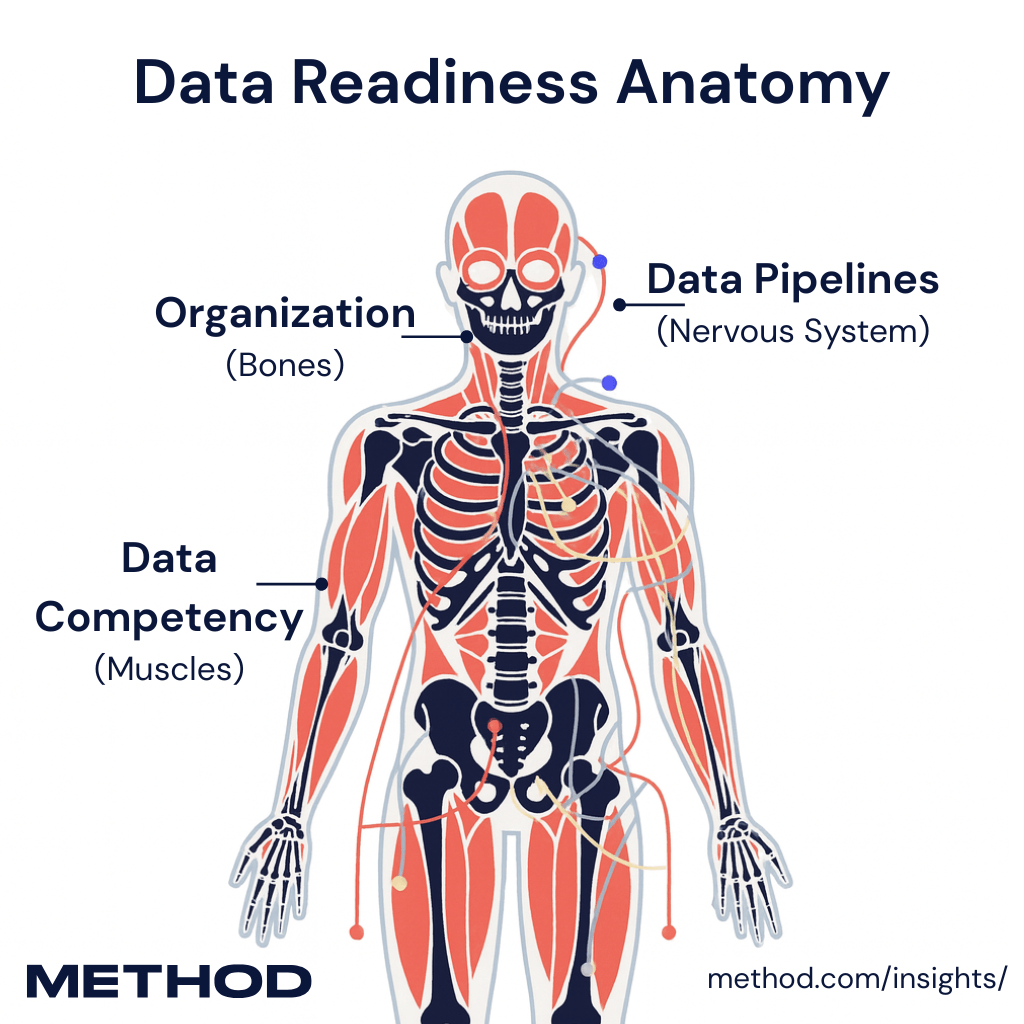
The Bones: Organization
A body without bones collapses into formless tissue. Similarly, a company without organizational strength around data lacks the structural foundation required to support AI. In this framework, bones represent culture, sponsorship, and capabilities.
Culture: Does the business value data?
Culture determines the body’s posture. If leaders view data as a secondary concern, their organizations tend to treat it as an afterthought. The result is brittle foundations.
The NewVantage Partners 2022 Data and AI Leadership Executive Survey found that 91 percent of firms had invested in AI and data initiatives, yet only 26.5 percent described themselves as data-driven organizations. That disconnect reflects a cultural gap: Leaders claim to value data, but they fail to embed it into their decision-making processes.
When organizations treat data as a first-class citizen, transformation becomes possible.
In the late 2000s, Procter & Gamble recognized that consumer insights were just as important as manufacturing scale. Leadership reframed data not as a byproduct but as a strategic input. P&G invested in analytics teams, democratized access to insights, and built processes to support data-driven decisions. This cultural shift enabled the company to innovate more quickly, launch products that aligned with consumer needs, and maintain its competitive advantage.
Culture isn’t a slogan. It’s the invisible bone structure that either holds AI initiatives upright or breaks them.
Sponsorship and Budget: Who nourishes the skeleton?
Bones require constant nourishment. In organizations, executives provide that nourishment through budget allocation and sponsorship. A skeleton can’t grow strong if leaders refuse to invest in it.
Consider Capital One, an AI-forward financial institution that declared itself a technology company that happens to do banking. Leadership followed up with billions of dollars in cloud migration, talent hiring, and platform investments. This combination of vision and budget created one of the most advanced machine learning operations among large banks.
Compare this with organizations that dabble in AI by funding one-off pilots but avoid making structural investments. These companies build proof-of-concept models that show promise, but without ongoing financial support and executive sponsorship, the skeleton weakens. Initiatives that lack organizational nourishment collapse under their own weight.
Capabilities and Skills: Can the skeleton hold securely?
A skeleton is useless if muscles can’t attach to it. Similarly, an organization’s bones must support the capabilities that allow data to move, adapt, and create value.
Data readiness requires multiple skill layers. Data engineers design and maintain pipelines. Data scientists develop and validate models. ML operations teams monitor and deploy those models at scale. And data literacy must extend to every level of the business so decision-makers can frame questions, interpret outputs, and challenge flawed recommendations.
Even with widespread investment, most organizations fall short in terms of skills. A 2023 study by the MIT Sloan Management Review and the Boston Consulting Group found that only 43 percent of employees felt comfortable using data in their decision-making. This gap reveals that without the right skill sets, organizations can’t build the muscular strength that AI requires.
Airbnb provides a standout example of a resilient organizational structure. The company launched an internal Data University program to boost data literacy across its workforce. Starting in 2016, Airbnb offered tiered courses, from introductory material suited for all employees to an advanced machine learning curriculum, tailored to Airbnb’s tools and data context.
Within the first year, the number of employees using its internal data science tools weekly rose from 30 percent to 45 percent, and over 500 team members completed at least one class. By investing in literacy at scale, Airbnb reinforced its cultural skeleton and enabled its data competence muscles to perform effectively.
The Muscles: Data Competency
If bones provide structure, muscles provide strength and movement. In data readiness, muscles represent competencies. Without them, an organization may have cultural support and talent, but it can’t move forward with influence.
Product Orientation: Build data as living products
Too many companies treat data as static assets, sitting purposeless in data lakes. This mindset mirrors a body that stores nutrients but never converts them into muscle. Successful AI initiatives require a product-oriented approach that treats data as a living entity delivering continuous value.
A data product includes ownership, documentation, clear quality standards, and interfaces for consumption. Uber’s Databook illustrates this principle: The platform acts as a central metadata catalogue, allowing teams to find datasets, understand their context, and trust their quality. By packaging data as products, Uber empowers engineers to build routing, pricing, and safety models at a global scale.
Domain Orientation: Align data with business language
Muscles must contract in coordinated ways to create movement. Similarly, if data doesn’t reflect a business’s logic, AI systems can’t produce meaningful insights.
Domain experts, not technical specialists, must define the taxonomy. They determine what constitutes a “merchant,” a “customer,” or an “order.”
Shopify exemplifies domain-aligned data beautifully: Its platform is organized around merchant-relevant domains, including products, inventory, orders, and customer checkout flow. The company’s Standard Product Taxonomy, a structured classification system for thousands of product categories and attributes, helped create consistency and clarity across its data systems. This domain logic enables AI models to forecast trends and merchant behavior with confidence.
Without domain orientation, organizations risk building muscular systems that flex in the wrong direction.
Cross Domain Orientation: Use technology to unify
A body needs connective muscles that move in sync. Similarly, organizations must unify cross-domain elements, such as security, logging, identity, and compliance, through a single platform.
Spotify’s Backstage is a great example of cross-domain unification. The internal developer portal consolidates services, documentation, and infrastructure into a single environment. Teams maintain autonomy yet benefit from consistent standards.
AI projects that depend on multiple domains, such as fraud detection that draws on transactions, devices, and behavioral data, thrive when a platform stitches the pieces together. Without this muscle coordination, organizations build fragmented AI capabilities that pull in different directions.
The Connective Tissue: Data Pipelines
If bones provide structure and muscles provide strength, connective tissue makes the body move as one. In data readiness, this layer appears as integration and governance.
Perspective across the organization
Organizations must recognize how data flows through every layer of the enterprise. Executives use it to inform their external strategy and competitive positioning, business unit leaders rely on it for resource allocation and performance tracking, and frontline staff depend on it for daily execution.
One public sector example comes from the UK Government Digital Service. Rather than a single product, GDS establishes common standards and fosters shared capabilities that help departments to use data consistently. Its cross-government roadmap outlines how departments will align on digital and data priorities and actions through 2025.
Additionally, GDS published the Digital, Data, and Technology Functional Standard to guide how the government should use digital, data, and technology so that services and analytics work together more effectively. GDS has also outlined work on a single data environment to enable end-to-end visibility across journeys, allowing teams to generate joined-up insights and improve services for citizens.
By aligning standards and shared capabilities across leadership, operations, and frontline delivery, the UK government turns data into connective tissue that supports coherent action.
Governance is the system’s brain
Governance functions like the nervous system. It sets rules, enforces standards, and fosters coherence, yet still allows teams to adapt locally.
A central compliance team defines privacy, security, and risk frameworks. Individual domains then apply those frameworks in their own context.
The European Union’s PSD2 regulation is a strong example. The directive requires banks to provide access to payment data via standardized APIs, subject to strict security protocols. At the same time, each bank retains control over how it handles data access within compliance guidelines. This hub-and-spoke governance model maintains consistency across institutions yet enables innovation in banking services.
Without strong governance, organizational data becomes fragmented. Muscles may twitch and bones may stand, but the system lacks coordination and purpose.
From Components to Cohesion
Data readiness depends on interconnected parts:
- The bones of culture, sponsorship, and skills provide structure
- The muscles of product orientation and domain alignment generate strength and motion
- The connective tissues of integration and governance bring the system into harmony
A healthy body adapts, grows, and sustains effort. A weak one collapses no matter how advanced its tools. To succeed with AI, organizations must imagine data readiness as a living physiology.