Customer acquisition has always been the first point of investigation for any growth strategy. A product or service only has value if it’s discovered, differentiated from competitors, and converted into a monetizable user.
With roughly $8 trillion in global e-commerce at stake, financial institutions can’t afford a passive approach to market share. AI is shifting how the best institutions address this challenge, and the movement is happening on two fronts simultaneously: reaching customers through hyper-personalized outreach at the exact moment a financial decision is being made, and making institutions discoverable to the AI agents increasingly doing the shopping on a consumer’s behalf.
Hyper-Personalization at the Moment of Decision
The most consequential shift in financial services customer acquisition is the move from mass outreach to precision targeting tied to specific life and financial moments.
For an existing small-business customer, this might look like a working capital loan offer surfaced through real-time analysis of accounts payable and receivable, along with historical cash or credit balances. For a prospective wealth management client, an offer might surface in their browser or AI assistant following searches tied to a key life event: a divorce, a business exit, or an inheritance.
What separates effective hyper-personalization from generic outreach is infrastructure. Financial institutions need confidence in their own data and the ability to ingest insights from third-party sources. That means building ingestion engines, real-time data and event pipelines, and identity graphs that recognize relevant signals as they appear.
The institutions getting this right aren’t just sending better messages. They’re meeting customers at decision points with offers that fit the actual situation.
Agentic Discoverability
Proactive outreach requires knowing who to target. But a growing share of customers are now finding financial products through AI tools rather than search engines. A 2025 Bloomreach survey conducted by Propeller Insights found nearly 60% of U.S. consumers aged 18–50 have used AI to help them shop online.
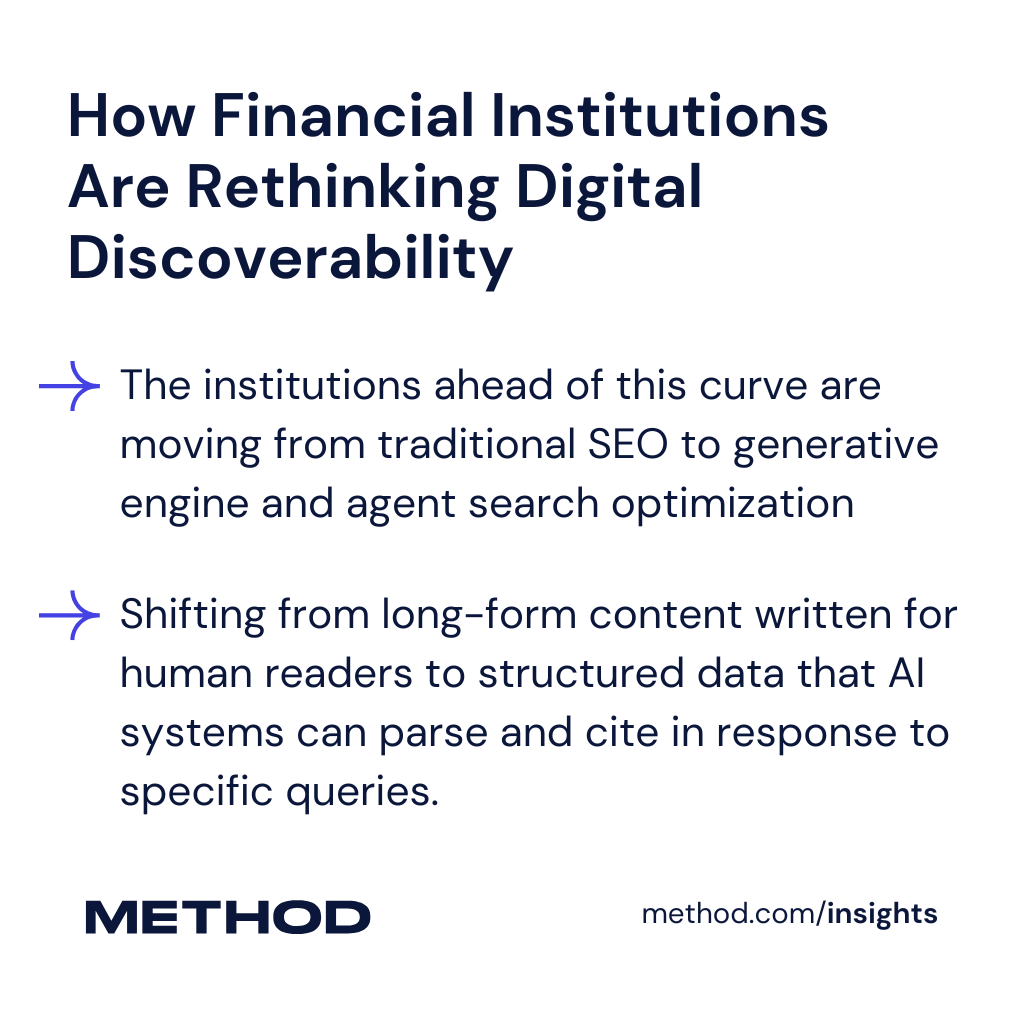
That has real implications for how financial institutions structure their digital presence. The institutions ahead of this curve are moving from traditional SEO to generative engine and agent search optimization. In practice, that means shifting from long-form content written for human readers to structured data that AI systems can parse and cite in response to specific queries.
Fidelity Go is a useful example of this approach in action. The product page leads with prominent numerical answers to the questions most likely to drive a comparison search: $0 in advisory fees under $25,000, $0 minimum to open an account. An extensive FAQ section across the overview and dedicated FAQ pages covers 35+ structured question-and-answer pairs, covering topics like fees, investment strategy, and account management.
These formats are easy for AI systems to read, parse, and cite when generating a robo-advisor recommendation for a specific user query.
The goal isn’t pages that rank on Google. It’s pages that can be read and cited by an AI system producing a recommendation in real time. Getting this infrastructure in place early is a compounding investment: AI systems learn to cite familiar, well-formatted sources.
How Method Approaches Next-Gen Customer Acquisition
Method has 25 years of experience in financial services, and our work on customer acquisition in the AI era draws on that depth across strategy, design, and engineering.
Every engagement starts with business objectives and user needs. Before any technical work begins, we map what has to be true across people, process, and technology to produce results. This outcomes-first approach keeps technical decisions grounded in what will actually move the needle.
On the agentic commerce side, Method is actively partnering with leading payments companies to build their first agentic commerce solutions. These engagements work across protocols including ACP, UCP, AP2, and MCP, integrating financial products into the infrastructure that machine-driven commerce runs on.
For institutions focused on discoverability, we help transition legacy web pages to machine-readable, schema-heavy digital assets. These aren’t cosmetic updates. They’re structural changes to how an institution’s products get discovered by AI systems making recommendations on behalf of consumers.
Ready to understand where your institution stands on next-gen customer acquisition? Reach out to Method today.