Consider the simple act of using a well-balanced hammer versus a cheap, plastic-handled substitute. One feels like an extension of your arm, weighted to assist the task and shaped to protect the hand, while the other is a blunt instrument designed for the lowest possible cost of production. We recognize this difference instantly in the physical world, yet we have become strangely tolerant of its absence in our digital lives. We have moved into an era where the industrialization of design has become the default setting, often at the expense of the very craft that makes a product worth using.
Design as a discipline did not emerge from a vacuum; it was established during the industrial revolution in the nineteenth-century with artists who were employed to help create differentiation. Mass production meant every ceramic plate or iron stove could be stamped out in identical thousands, and manufacturers realized that aesthetic choice and ergonomics were the only ways to stand out in a crowded market. Design was born as the bridge between efficiency, mass production and the preferences of the customer, it was a tool for differentiation.
We have seen this cycle repeat across different eras. From visual differentiation in the 1920s to streamlined functionality mid-century and the precision of digital products since the dot-com bust. Design has always adapted to the tools of its time. Each phase was met with a fear of loss—a worry that the machine would erase the hand of the maker—yet each time, the discipline emerged more refined and more essential to the business model.
We are standing at the threshold of our next transformation, the system is once again being dismantled and rebuilt and the tension between industrial change and the role of design is in play. Change is constant across eras, how we approach it and choose to respond is up to us.
The driver of this current shift is the rise of agentic AI. Unlike the static tools of the last decade, these systems do not just wait for a command; they promise to anticipate needs, manage workflows, and execute production tasks with a level of autonomy that mimics a member of the team. This represents the ultimate industrialization of design production: not simply faster execution, but a restructuring of the production line itself, where concept exploration, layout variants, adaptation, QA, and handoff can be continuously generated and tirelessly refined.
For business, profound optimization allows for the automation of workflows previously requiring endless hours of manual labour. Just-in-time manufacturing revolutionized physical production through industrial efficiency, Agentic AI is now applying those same principles to digital and creative workflows. Design in this era, becomes less a series of discrete outputs and more a continuously running system that delivers designed artefacts on demand. The constraint is no-longer how much design can be produced, but the curation of what should be produced.
In our immediate future, we must recognize two distinct but equally vital pathways. The first is the industrialization of the mundane. There is no strategic advantage in squandering human talent on manual high-volume, repetitive processes when agentic systems can govern these workflows with absolute consistency. Whether it is the resizing of design assets or the implementation and application of a design system, these tasks represent an overhead of time that can and should be industrialized. Designers become responsible for setting the constraints that shape production. Stewards of quality in a new sense, no longer limited to perfecting pixels, but ensuring the machine produces with intent, against desired taste, accountability and strategic boundaries.
The second pathway demands a return to the craft of observation and the rigor of critical thinking. As the machine assumes the burden of producing the artifact, the designer must reclaim the territory of human insight and its translation. A deliberate departure from the screen to enter the physical world, where behavior is nuanced and often defies the logic of a data dashboard. Moving beyond metrics into real-world contexts, where social cues, habit, emotion, and culture often override rational, measurable patterns. Turning away from the race to produce more, leaning into a discipline of choosing better by defining the right problems. Making what matters to humans through principled trade-offs, while shaping systems as they adapt. Here, human insight isn’t a nice-to-have, it is the art of noticing what data can’t explain, and the craft of translation, to drive outcomes that meet human needs.
For a business, the rise of automation offers a tempting promise of infinite, polished output at near-zero cost, yet this creates a significant strategic risk where products look correct but fail to resonate with the people they serve. A digital platform can be aesthetically perfect while remaining functionally bankrupt, creating friction for the employees who must operate it and alienation for the customers who are expected to navigate it. The danger is assuming scale equals value. Efficiency without empathy is a liability and the quality of output and experience becomes your differentiator.
Orchestrating systems intentionally is critical as our technology landscape expands from the screen into physical infrastructure. Those who visited or watched what happened at CES will have observed a shift. We are entering a transition towards the era of Physical AI, where the convergence of Information Technology (IT) and Operational Technology (OT) is no longer a speculative future but a present-day business reality. Organizations like Hitachi are demonstrating the next generation of social innovation, driven by AI integrated into the energy, rail systems and manufacturing lines that sustain our society and enable us to function. For designers, this means our remit and the materials we work with are expanding; we are no longer just designing interfaces and flows, but influencing systems that impact carbon neutrality, urban resilience and the fabric of our societies.
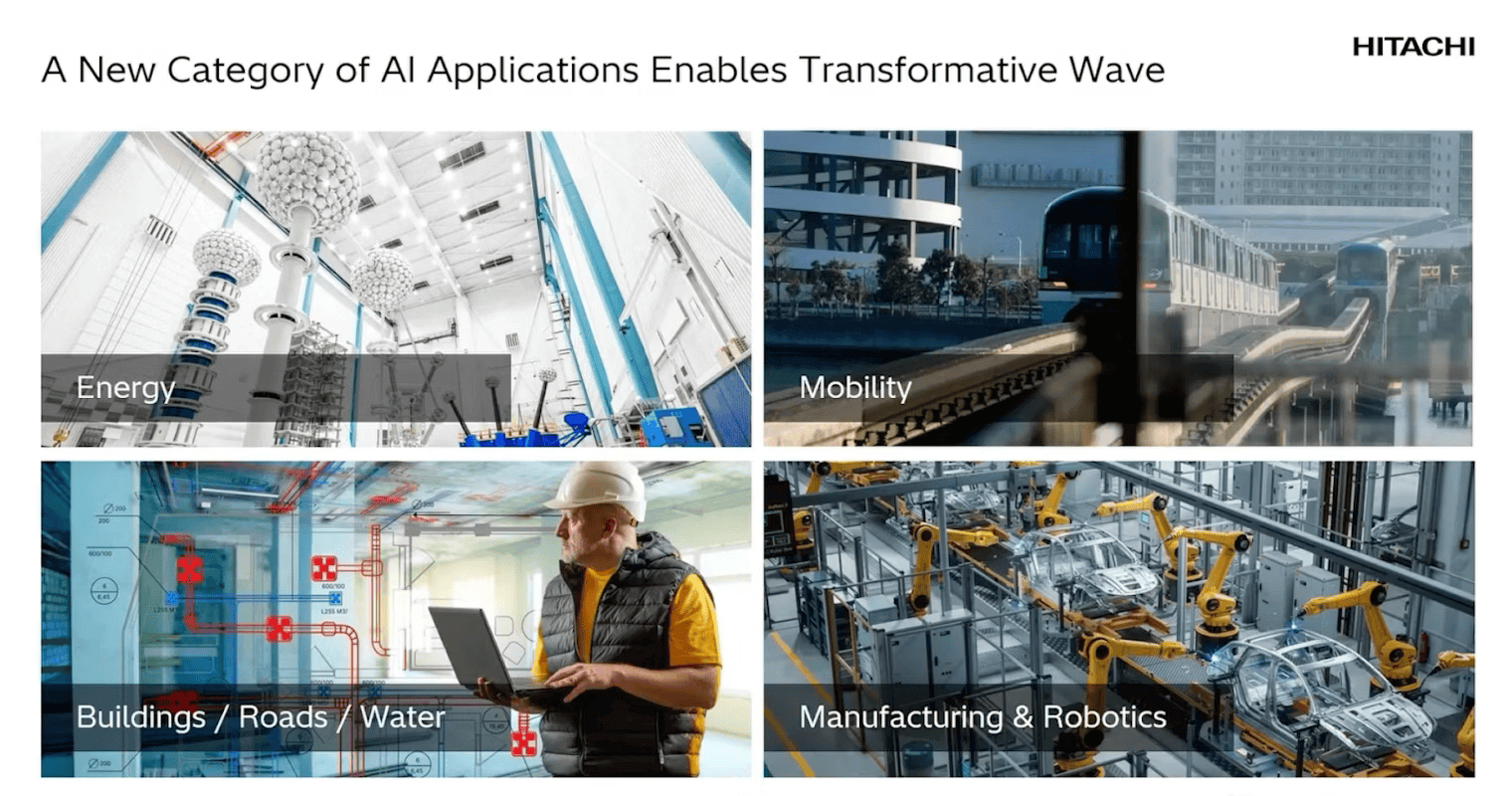
Hitachi CES image if you want it as inspo
When AI expands into the physical world and manages critical infrastructure, foresight and a human focus are our safeguards against systemic failure. Insight and systems thinking are essential when people’s lives are at stake, it’s not a task to be taken lightly. In a Physical AI future, design can not be just an aesthetic luxury or a series of interaction flows, when we touch the structural integrity of business and society.
Our path forward requires a shared understanding that as the technology landscape reshapes, the metrics of success have fundamentally shifted too. It is no longer okay to “move fast and break things” and to produce at scale; we must study lived behaviour and the physical world, produce with intent that is deeply rooted in human empathy and understanding, design with accountability and boundaries and keep humans squarely in the loop.
In our predicted future, agents are fundamental, shaping the products and services around us dynamically and in real time. We have woven behavioral DNA into the architecture of our lives, giving them licence to predict our behaviour against a synthetic version of ourselves, our digital-twin of one. Ahead is an era of zero customer churn fueled by business models that don’t just react to our needs, but anticipate them through millions of simulated outcomes, becoming our partners, collaborating between our synthetic selves and the brands that actually “get” us. We have pivoted from selling features to delivering on human potential, not only cutting costs, but delivering the space and time to re-imagine and unlock free-time for new value creation and innovation.
What we believe now, history also shows us, is unlikely to be as initially imagined. Many a strongly held belief gets left behind when humans and technology meet, or takes significantly longer to be true. The 1975 paperless office, the 15 hour work week of the 1930s, and the 1955 nuclear vacuum cleaner to name a few. Predicting what it means to be human with technology is an art that few master with precision. Remaining curious, open but also grounded becomes an essential and valuable skill for navigation.
So what should we take away? Pathway one, the industrialization of the mundane, is the foundation of efficiency, while pathway two, the craft of observing real, situational human behaviour and strategic design, is your engine for relevance. When these two paths are understood, we move beyond automation at a surface level to build high-integrity systems that are technically resilient and human focussed. True competitive advantage in this next era will not belong to those with the most powerful algorithms, but to those who use that power to protect the non-negotiables of human necessity. And with that, the discipline of design adapts again.