SaaS companies are facing pressure to integrate AI into their products and operations. Boards want AI strategies. Customers expect AI features. Competitors are shipping AI-powered capabilities.
But the path from “we need AI” to actual deployment often stalls at one juncture: the business case.
Too many SaaS companies approach AI investment with vague promises of efficiency gains or a general sense that they’ll fall behind without it. Neither justification survives budget scrutiny.
A strong AI business case requires answers to three questions: How will this create value? How will we capture that value? And how will we sustain our advantage over time?
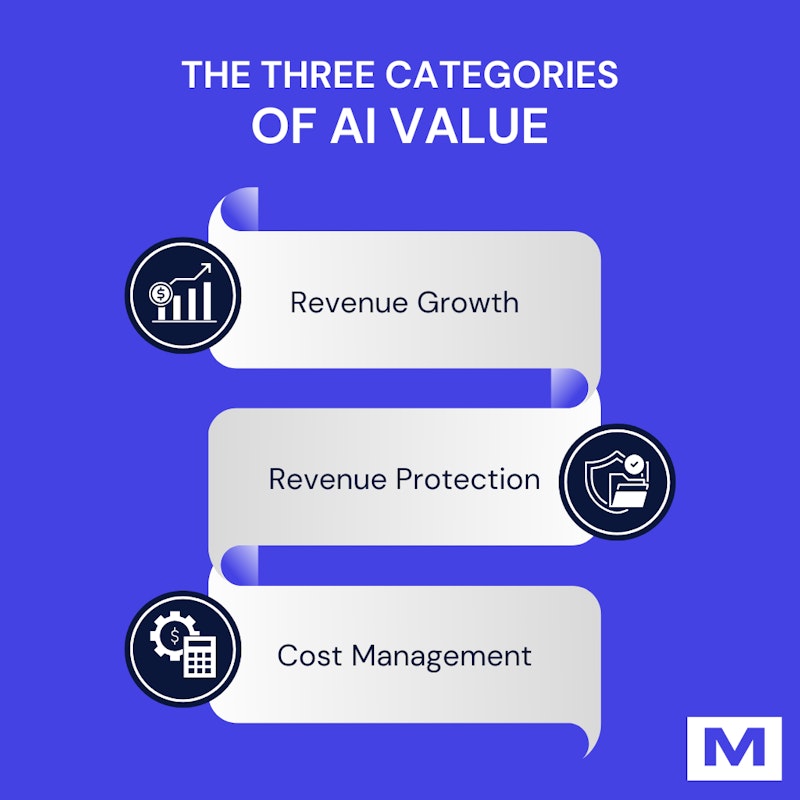
The Three Categories of AI Value
AI investments for SaaS companies fall into three value categories: revenue growth, revenue protection, and cost management.
Each requires different success metrics, different risk profiles, and different timelines to ROI.
Revenue Growth Strategies
Growth-focused AI initiatives aim to increase ARR and margin through new revenue streams or expanded market reach. These are offensive plays.
New product development involves deploying standalone AI solutions or premium AI features bundled separately from your core product. HubSpot’s AI assistant and GitHub Copilot follow this model. The business case here rests on incremental revenue: What will customers pay for this capability that they wouldn’t otherwise pay for?
Premium tier justification bundles AI features into higher-priced plans as part of an upsell strategy. Atlassian and Canva have taken this approach. The business case centers on conversion rates from lower tiers and reduced churn at premium levels.
Customer and user expansion uses AI to unlock new buyer segments. This might mean moving into new industries, serving different company sizes, or reaching new departments within existing accounts. Gong has executed this strategy well. The business case requires market sizing for the new segments and realistic assumptions about changes to the sales cycle.
Verticalization tailors AI capabilities for specific industries. Salesforce’s Agentforce Assistant is one example. The business case depends on whether vertical-specific features command premium pricing and reduce competition from horizontal players.
Data and model licensing provides access to AI models, enriched data, or raw data via APIs. This works when your data has value to parties outside your existing customer base. The business case requires an honest assessment of data uniqueness and quality.
Revenue Protection Strategies
Protection-focused initiatives use AI to reduce churn, improve product economics, maintain feature parity, and defend against disruptors. These are defensive plays, and they’re often harder to quantify than growth initiatives.
Productivity solutions deliver efficiency gains and cost savings for customers. Zendesk has built AI capabilities around this value proposition. The business case ties to customer retention metrics and willingness-to-pay research.
Optimization of existing features uses custom fine-tuned models to improve automation or intelligence capabilities you already offer. Intercom has followed this path. The business case compares the cost of improvement against the cost of losing customers to competitors with better AI.
User stickiness creates features that users rely on daily, making it difficult to switch providers. LinkedIn has embedded AI throughout its user experience for this reason. The business case measures engagement metrics and their correlation with retention.
Feature modernization uses AI to update the product experience and improve brand perception. Asana has invested here. The business case is part quantitative (retention, NPS) and part strategic (market positioning).
Standard use cases cover capabilities that will become table stakes: streamlined onboarding, AI-driven intelligence, support automation, workflow optimization, intelligent search, and embedded analytics. The business case for these is defensive: What happens to retention and competitive position if you don’t have them?
Cost Management Strategies
Cost-focused initiatives apply AI to internal operations. These have the clearest ROI calculations but the lowest strategic value.
Product development acceleration uses AI tools to reduce cycle time, decrease defects, and improve efficiency across product, design, engineering, and QA functions. Early benchmarks suggest 12–25% increases in developer throughput, 40–60% reductions in story writing time, and 25% faster code reviews when AI assistance is applied well.
Documentation and release management applies AI to technical writing, training materials, knowledge management, and product support content.
Customer support automation uses AI to handle routine inquiries and route complex issues more efficiently.
Client lifecycle optimization deploys AI across marketing, sales, implementation, and client operations.
Product analytics identifies usage patterns and improvement opportunities through AI-powered analysis.
The business case for cost management initiatives is straightforward: reduced headcount needs, faster time-to-market, or improved quality at the same cost. But efficiency gains alone rarely justify AI investment at the board level.
Why Efficiency Isn’t Enough
Here’s where many AI business cases fail: they stop at task-level productivity improvements without addressing systemic value creation.
A developer who writes code 25% faster doesn’t translate to 25% faster product delivery. Bottlenecks exist throughout the system: in portfolio strategy and prioritization, in decision-making processes, in discovery and validation, in release management, and in CI/CD pipelines.
AI efficiency gains are necessary but not sufficient for full business ROI. Teams need to use their additional capacity for value-creating work. The system can’t bottleneck elsewhere.
A complete business case addresses four questions outside of raw efficiency:
- Quality and maintainability. Will faster output maintain quality? What happens to the total cost of ownership if AI-generated code requires more maintenance?
- Capacity planning. What will teams do with their freed-up time? Is there a backlog of high-value work waiting, or will efficiency gains simply reduce headcount needs?
- Measurement and flow. Where are the bottlenecks that prevent efficiency gains from reaching customers? Which constraints limit throughput?
Vision, strategy, and work identification. Is there valuable work for teams to do? Efficiency without direction just means doing the wrong things faster.
Building Your Data Advantage
The most durable AI business cases include a strategy for long-term competitive advantage. For SaaS companies, that advantage often comes from data.
Not all data creates an advantage equally. Evaluate your data assets across five dimensions:
- Proprietary access. Do you have exclusive data based on product usage, partnerships, or integrations competitors can’t easily replicate?
- Volume and scale. Do you have enough data to train or fine-tune models in ways that publicly available information can’t support?
- Relevance and freshness. Is your data constantly updated, refined, and refreshed? Is it part of a feedback loop that improves context over time?
- Structure and enrichment. Has your data been refined in ways that improve model training or tuning?
- Interconnection. Does your data connect disparate domains or workflows to enable deeper insights?
The business case for data advantage is longer-term than immediate feature development, but it’s often more defensible. A competitor can replicate your AI features. Replicating your data moat is much harder.
The Questions Your AI Business Case Must Answer
A strong AI business case for a SaaS company answers these questions:
- Which value category are you targeting: growth, protection, or cost management? What specific strategy within that category are you pursuing? What metrics will define success, and over what timeline?
- How will you monetize the investment? New product revenue? Premium tier conversion? Reduced churn? Operating cost reduction? Each monetization path requires different assumptions and different validation.
- What’s your path to sustainable advantage? How will you prevent competitors from quickly matching your capabilities? What data assets or feedback loops will compound your advantage over time?
- How does this fit with your broader product and technology roadmap? AI initiatives don’t exist in isolation. They depend on architecture decisions, data infrastructure, and team capabilities that take time to build.
Method Helps SaaS Companies Build AI Strategies That Survive Board Scrutiny
We work with technology and SaaS companies to define AI use cases, validate business cases, and build roadmaps from ideation through deployment. Our approach combines strategic consulting with hands-on product and engineering expertise, so recommendations don’t die in PowerPoint.
If you’re building an AI business case and want a partner who can pressure-test your assumptions and accelerate your path to value, reach out today.