Use the physiology metaphor — viewing data readiness as a living entity in which Organization is the bones, Data Competency is the muscles, and Data Pipelines are the nervous system — to respond to each challenge and turn brittle systems into resilient AI.
AI adoption doesn’t fail because the technology lacks sophistication. It fails because the body supporting the technology can’t stand upright, move with sufficient strength, or coordinate its parts. The physiology metaphor helps leaders recognize that success depends on cultivating organizational structure, building competency, and strengthening governance.
Mapping Challenges to Physiology
Let’s revisit the ten challenges from part I and map them to the three layers of physiology.
- Data quality and integrity require strong bones and disciplined muscles. Without a culture that values data hygiene and teams capable of engineering clean pipelines, organizations pump noise into their models. A body with brittle bones can’t support healthy muscles, and an enterprise with a fragile culture can’t support high-quality data.
- Bias and representation demand domain-oriented muscles and connective governance. Only domain experts can define what “normal” means in context, and only governance can write definitions that stay consistent across the organization. Otherwise, AI repeats historical discrimination.
- Accessibility and silos expose weaknesses in connective tissue. If data can’t flow across the body, muscles starve and bones atrophy. Platforms that unify access and governance frameworks act as ligaments, moving information appropriately.
- Volume versus value tests both culture and product orientation. Leaders who celebrate raw volume without embedding data product thinking build heavy but useless muscle. A culture that rewards outcomes makes muscles strengthen in ways that actually matter.
- Labeling and annotation depend on skilled muscles. Without trained people, annotated datasets remain scarce and costly. Organizations that invest in shared platforms for labeling or partner with external data providers strengthen their muscles in ways that empower AI.
- Timeliness and latency rely on connective tissue. Real-time monitoring and responsive pipelines keep the nervous system firing. Without integration and data flow, AI acts like a body that receives signals too late to react.
- Privacy, security, and compliance sit squarely within the brain of governance. Central teams must enforce standards, yet domain teams apply them responsibly. Without this layer of connective tissue, organizations risk paralysis through mistrust or regulatory sanction.
- Interpretability and provenance live in the brain. A healthy nervous system tracks signals across the body. Provenance gives every data point a traceable path, which makes AI trustworthy and defensible.
- Scaling across domains requires strong muscles and connective tissue. Each domain must manage its own data definitions, but a shared platform must enable interoperability. Without this balance, scaling becomes a transplant rejection, where the body attacks its own new parts.
- Change management demands resilience across the whole physiology. Bones must stay flexible, muscles must adapt, and connective tissue must coordinate responses. A resilient body survives shocks like COVID-19. A rigid one collapses.
Case Studies Through the Physiology Lens
Airbnb: Building literacy as bone strength
When Airbnb recognized the limits of its data culture, it launched Data University, a program that trained employees across functions to use data fluently. Within a year, the rate of employees using internal data tools weekly grew from 30 percent to 45 percent, and more than 500 employees completed at least one class.
By strengthening literacy across the organization, Airbnb gave its data ecosystem stronger bones. Those bones supported the muscles of analytics and experimentation that run its recommendation engines and marketplace dynamics.
Capital One: Feeding the skeleton with sponsorship
Capital One’s leadership declared technology would define the company’s future, and they invested accordingly.
Capital One migrated aggressively to the cloud, built strong MLOps pipelines, and hired hundreds of engineers and data scientists. This strategic nourishment built strong bones that could carry advanced AI systems’ weight.
Today, Capital One uses machine learning to detect fraud in real time and personalize credit decisions.
Uber: Treating data as muscle
Uber struggled with data chaos as it expanded worldwide. Teams duplicated datasets, defined terms differently, and lacked consistent quality. Engineers responded by building Databook, a metadata system that organizes data products with clear ownership, lineage, and quality signals.
By treating data as a product, Uber developed the strong muscles its routing, pricing, and fraud detection systems depend on.
Spotify: Strengthening connective muscle
Spotify developed Backstage, an open-source developer portal that provides unified infrastructure, documentation, and service discovery. This platform allows domain teams to move independently yet still work within consistent frameworks.
Backstage behaves like the tendons that tie muscles together. For AI, this integration makes models combine signals across domains without confusion.
UK Government Digital Service: Building connective tissue
The UK Government Digital Service recognized that siloed data weakened public services.
To address the issue, GDS published the Digital, Data and Technology Functional Standard, which provides common rules for using data across departments. The government also launched the Transforming for a Digital Future roadmap, which sets priorities for aligning data and technology through 2025.
By enforcing shared standards while enabling departmental autonomy, the UK government created the connective tissue that allows policy, operations, and citizen services to work together.
Healthcare: Governance as the brain
Healthcare illustrates governance’s necessity.
After the UK’s Information Commissioner’s Office ruled that the Royal Free London NHS Foundation Trust had improperly shared 1.6 million patient records with Google DeepMind, the NHS strengthened its governance requirements. This decision reinforced the importance of transparent rules, a lawful basis for data use, and transparency.
Governance acts like a brain, making every part of the body function coherently.
Practical Pathways for Leaders
The physiology framework isn’t just a metaphor. Use it to design practical pathways toward data readiness:
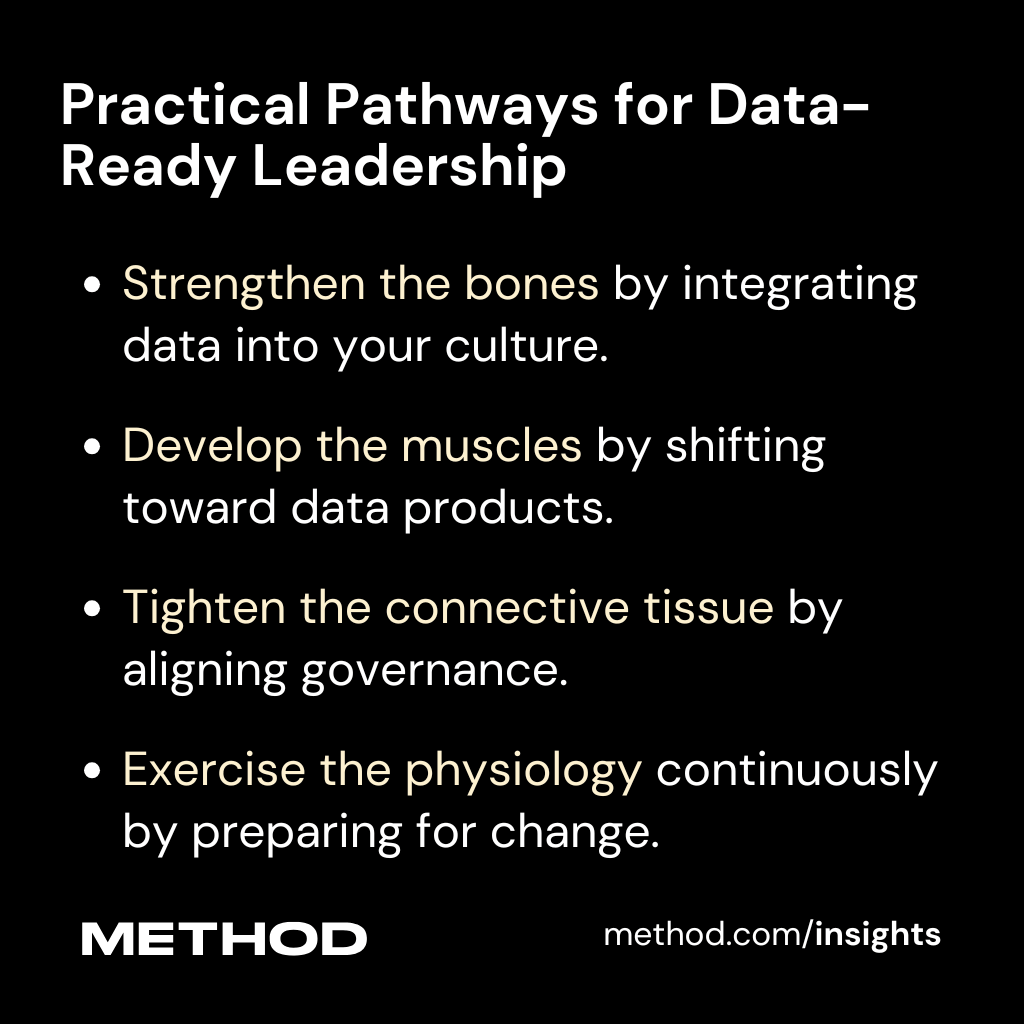
- Strengthen the bones by integrating data into your culture. Appoint a Chief Data Officer with executive authority. Fund data platforms as infrastructure rather than discretionary projects. Train employees in literacy programs modeled after Airbnb’s Data University.
- Develop the muscles by shifting toward data products. Establish domain-oriented data models that reflect the business’s language. Empower domain experts to steward definitions and metrics. Build platforms like Uber’s Databook or Spotify’s Backstage to give teams reliable strength.
- Tighten the connective tissue by aligning governance. Create hub and spoke models where central teams define standards for privacy and compliance and domain teams apply those standards. Publish functional standards, as the UK government did, to create clarity across the enterprise.
- Exercise the physiology continuously by preparing for change. Models decay, data shifts, and regulations evolve. Leaders must treat data readiness like physical health. Train, monitor, and adapt every day, not just once.
The Path to Strong Data Physiology
Organizations that ignore the body metaphor will continue to suffer from brittle systems. They’ll watch pilots succeed in isolation and fail at scale. They’ll experience sudden collapse when conditions shift.
Those who invest in healthy data physiology will exhibit distinct, supple movement patterns. Their bones will provide stability through culture and sponsorship. Their muscles will generate strength through product orientation and domain alignment. And their connective tissue will integrate the body through governance and perspective.
A 2023 survey by Deloitte found that 79 percent of executives expect AI to change their businesses within three years, but only 17 percent feel confident that their organizations are ready. The physiology framework closes that gap. It gives leaders a way to move beyond slogans and investments toward systemic readiness.
Final Thoughts: The Physiological Imperative
AI succeeds when organizations build strong bones, powerful muscles, and resilient connective tissue around their data. Culture, skills, product thinking, domain alignment, integration, and governance all work in tandem to create a living system.
A healthy body adapts to stress, heals from injury, and grows stronger with use. An unhealthy body collapses, no matter how advanced the tools used to treat it are. Leaders who prioritize data readiness prepare their organizations not only to deploy AI but to thrive with it. They build systems that learn, adapt, and endure.
The future of AI belongs to organizations that cultivate living, breathing, resilient data ecosystems that empower their people, align with their domains, and move in coordinated action — organizations that treat data not as currency or oil but as physiology.