You’re not thinking big enough — is probably something we don’t often hear when it comes to AI. Most C-suits are dreaming of ways to reduce the workforce and digitize the entire process, but the reality of that future is quickly falling short of cost-saving promises, with 95% of GenAI pilot programs falling.
On the other hand, most of the GenAI that companies are successfully piloting, the 5%, is focused on solving for a singular business pain point, and executing well, closer to a sibling of rule-set automation that has existed for years, rather than the transformational technology being promised. So how do we change the trajectory? We adjust our approach and think big — systems thinking big, moving from plain automation to true transformation.
Thinking in systems is fundamentally different from our most common approach to problem solving, linear thinking. In linear thinking we assume there is a cause-and-effect relationship, which works well when we talk about how to update software with a new feature, but if we’re looking to create organizational impacts, like changing our workflows, those problems are more complex and dynamic.
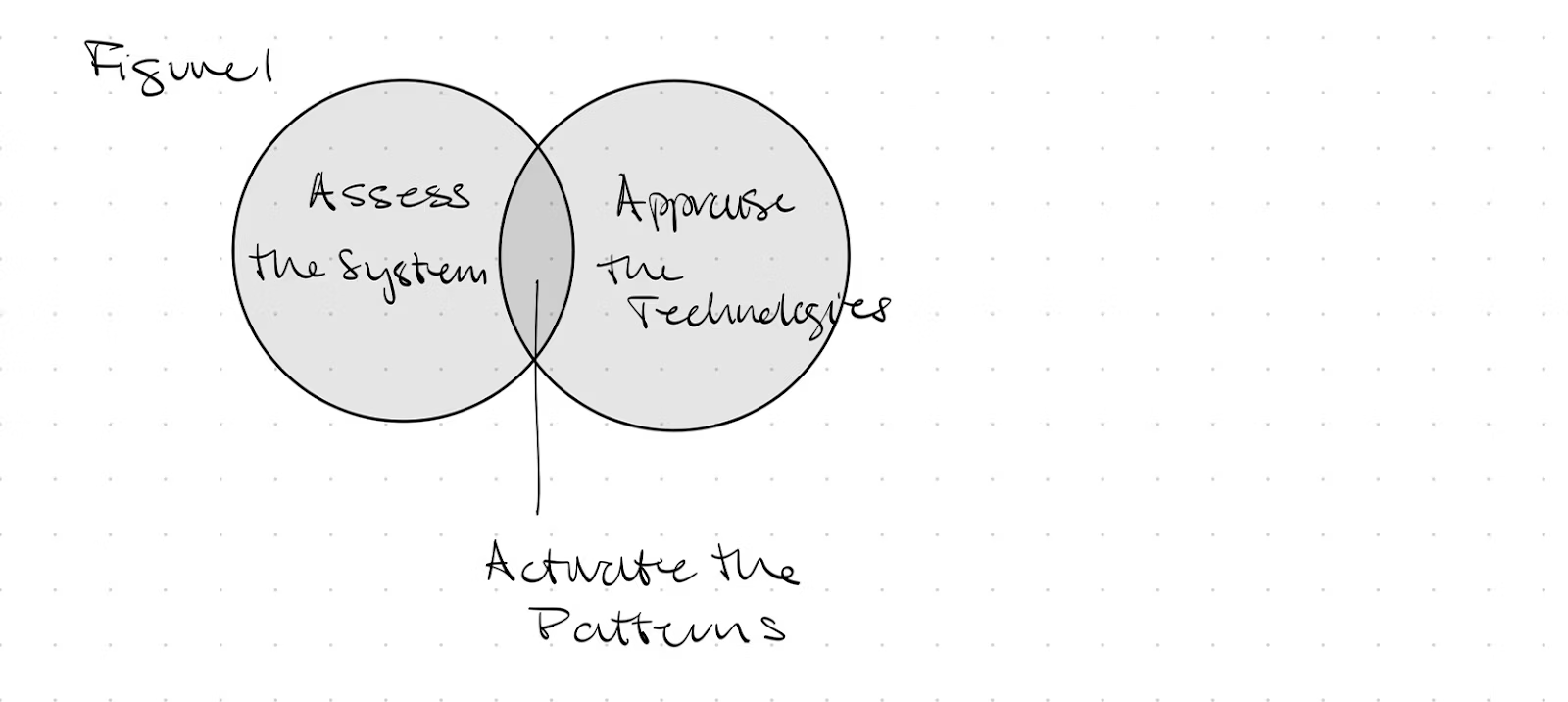
[Assess the Systems: Surface the recurring challenges across people, product, platform, performance, and planet.
Appraise the Technologies: Understand where AI and other technologies are strong, and where they fall short.
Activate the Patterns: Connect pains to strengths to create focused, high-impact solutions.]
Imagine a venn diagram for this non-linear approach, on the left we want to spot the pains, by triangulating problems we find across multiple systems, highlighting specific issues with high-impact. While on the right, we want to understand the different strengths and weaknesses of multiple technologies, and find the right tool for the job. In the overlap, by matching these together a new pattern emerges, shifting us from solving pains one-at-a-time to tackling multiple challenges through a targeted approach, ultimately delivering valuable solutions with higher impact across organizations and workflows.
In the world of innovation, systems thinking gained popularity after Peter Senge’s bestseller The Fifth Discipline was published in the 1990s. However, a resurgence in the approach can be found across Harvard’s Business Review, the World Economic Forum, and even in Don Norman’s 2023 book, Design for a Better World, which highlights how our actions impact the global system. All of these urge businesses to look at the bigger picture, especially when solving complex issues, to produce a robust framework for change.
While AI will arguably touch every aspect of our world, from our environment to our workforce, and even power structures, as Kate Crawford argues in Atlas of AI, for good reason. Many industry leaders today face mounting pressure from shareholders and $500 billion of market investment to quickly implement AI-powered solutions, without determining if those solutions are even solving the right problems. Businesses are short on the time needed to gather the information required to deep dive into AI’s impact on larger systems, but also lack the information required to make decisions on smart technology investments and create valuable solutions for their businesses.
So how can we leverage this framework when building AI solutions – which many believe are driving a technological revolution – while still keeping pace with today’s fast-moving business demands?
Assess the Systems: Surface the recurring challenges across people, product, platform, performance, and planet.
While I’m an avid fan of in-depth analysis, and wish everyone could spend the time to ideate through all possible outcomes for every system, the realities of business and even academia make it impossible to achieve.
However, we can start by looking at five key systems — people, product, platform, performance, and planet. Identifying the key systems that AI impacts, can assist us in triangulating critical pains found in the current processes and expose patterns that have a high-impact on the workflow. These five key systems are critical when developing a digital experience because they ensure that solutions are not only user-centered, but operationally feasible and strategically aligned, and truly sustainable, delivering adoption, measurable business impact, and enduring value. People represent user needs and behavior loops that impact user actions. Product captures tangible interfaces that users touch. Platform embodies the architecture and data that helps us build at scale. Performance ties us back to business needs and objectives, moving the needle where it counts. Planet, focuses on real sustainability, encompassing the environment, social and financial sectors through making choices that hold up in the world creating long lasting wins and business durability.
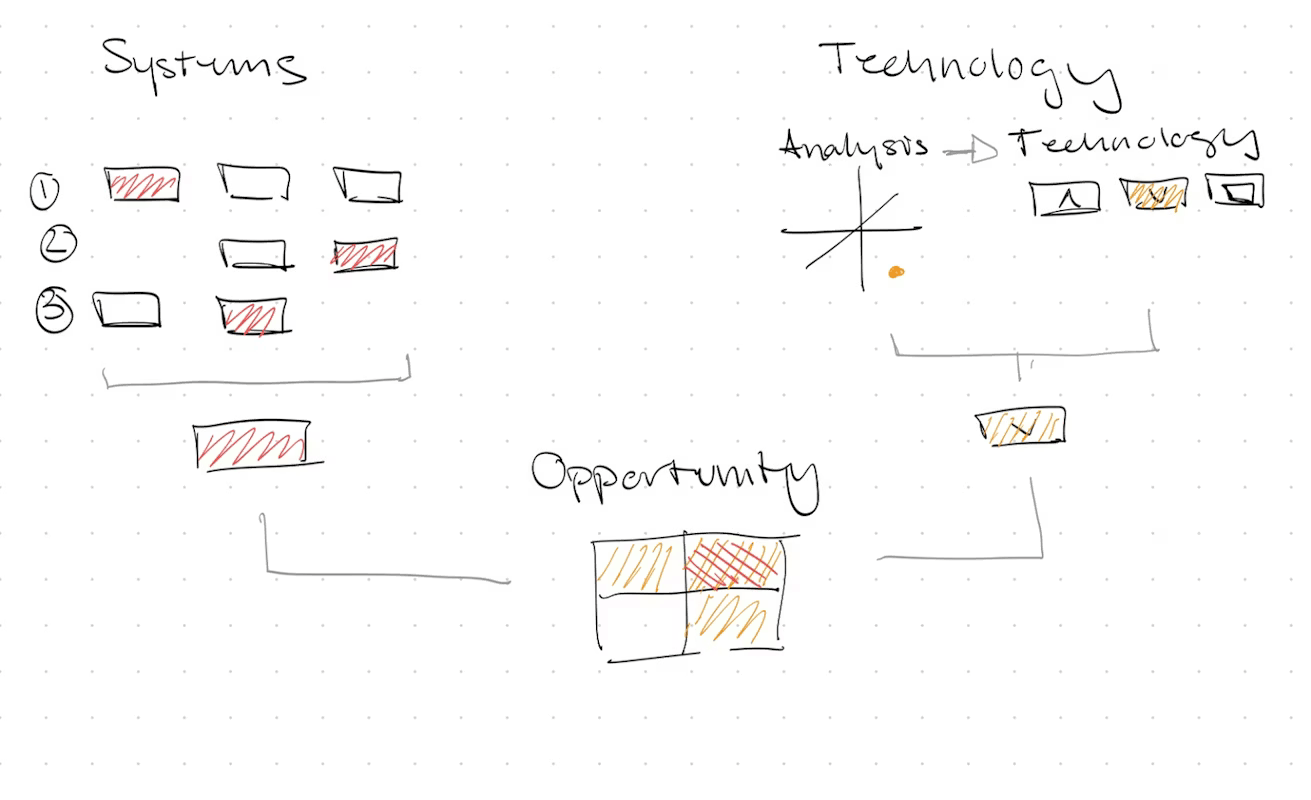
Teams and leaders can identify each of these systems’ individual pains and map their relationships on visual tools like service blueprints to expose larger patterns that have an impact across an entire process rather than for one specific step.
Appraise the Technologies: Understand where AI and other technologies are strong, and where they fall short.
Understanding how to unlock a new technology’s transformational abilities doesn’t come from using it as a replacement for past tools, like rule-based automation, it’s about using it in new ways. A lot of money is being spent on replacing old tools for shiny new ones, in part because we’re all speaking different languages. While many business leaders think AI is a new word for automation, technologists have a much different understanding of what that means, because fundamentally AI has different strengths and weaknesses than previous technologies.
With that in mind, after years in the design world, developing places, products, and services, while you can hammer a screw into a wall, it’s an ill-fitted and more expensive solution than required, and probably why we see the data found in The GenAI Divide: State of AI in Business 2025 report. As a designer, I’m excited about developing meaningful solutions, especially when it comes to AI, but it’s not always the answer – it’s another tool in our ever-growing toolkit.
What stands is that AI is an excellent pattern machine, and there are specific patterns it is great at solving — like pulling lots of information or documents into one source of knowledge. Understanding where AI excels or fails to meet expectations can help guide us in its application. While growing investments are being placed into AI research, these patterns will continue to shift over the next few years as the technology develops.
While technologists are necessary for solutioning with their depth of knowledge, business leaders can also be thinking about this through a more strategic lens through an AI risk analysis framework, as found in The AI Conundrum by Caleb and Rex Briggs. The authors make a case that ideal AI solutions should be of low precision, low need for rational, and high input control. Meaning that some of the ideal patterns for AI may be in areas such as marketing applications where low precision and rationale are acceptable, and have high input control, such as pitch generation or audience selection.
Activate the Patterns: Connect pains to strengths to create focused, high-impact solutions.
Non-linear thinking allows us to approach solutions through multiple lenses allowing us to clarify both the pain points and the role that AI technologies can realistically play. By shifting our focus to the relationships between these two, we have created a set of structures to approach a complex problem, allowing us to not only identify the right problem, but create solutions that will have an outsized value when implemented, moving from quick solves to strategic plays, with cost-effective solutions that scale.
Finding the relationship of these systems is a pattern matching exercise, so when designing for AI solutions, this requires us to understand the job that we need the data to do, so we can match the best AI tool based on the pattern we need that data to achieve. By breaking it down this way we can categorize data functions into different patterns such as automatic, programmatic, or agentic, helping us to refine our lens for developing solutions.
Opportunity areas help us create a refined lens in which to match these patterns, by using service blueprints which give us a visual representation of the repeated pains across the system in combination with frameworks to understand where technology best fits, this refined space for ideation can reveal the design requirements necessary for creating a targeted solution for systemic issues.
By matching patterns through this non-linear structured approach, leaders can align cross discipline teams via visual representations, helping everyone to speak the same language. And through structured ideation via high-impact opportunity areas, leaders can uncover the design requirements and information necessary to make larger strategic decisions, such as buy vs. build, reducing both the time and cost associated with finding AI solutions for implementation.
Narrative Study: Connect Wellness
Let’s illuminate an example of a medical grade connected wellness company. The company wants to reimagine its customer experience due to low customer satisfaction. Leadership has heard about AI-powered solutions like customer facing chats, and wants to understand if it’s the right tool for them, or if there is something better fit.
Assess the Systems
The company starts by taking a comprehensive look at the key systems involved in the digital experience to get to the bottom of declining CSAT scores. By looking at these patterns or friction they are able to clarify where issues are interconnected.
The assessment reveals that a core complaint is how long calls take from the customers perspective. Breaking down the employee workflow, the most time spent in calls is gathering information. Additionally the information is across multiple documents, and can be outdated. Observing the product employees use to interface with customers, simple information is hard to find, and pushes employees to multi-step, time consuming searches. Beneath the surface, fragmented data architecture is making this even slower, because the platform struggles to surface information efficiently. Finally we see that since CSAT scores decrease, more products are being returned due to troubleshooting missteps creating increased logistics cost and supply chain inefficiencies.
Together, the assessment clarified that declining CSAT scores were actually a symptom of a larger systemic challenge: making information accessible across the organization.
Appraise the Technologies
With the problem defined, leadership looked to appraise the possible technological solutions. Using a risk analysis framework, and applying their problem inside the framework, the business realized the right tool needs the following:
- High Input Control: AI’s knowledge should be exclusively from their own trusted, proprietary data, ensuring answers are relevant, secure, and aligns with the brand.
- High Rational: Agents need to understand the reason behind the correct answer, and should be able to easily cite the information so they can understand the “why” and communicate it efficiently.
- High Precision Tolerance: For our products there isn’t much room for error, so using AI alone isn’t the right solution for us, we need human augmentation to bridge the gap, ensuring answers are precise and contextually aware.
This gave leadership clear parameters to give to their data specialist who reviewed the information and decided that an agentic tool, built on RAG? Was the optimal fit to provide verifiable and source-backed information.
Activate the Patterns
Finally, by understanding the data’s primary job, to be a single source of truth, that an agentic tool can use to synthesize the information, audit answers, and augment human customer service agents, they decided on an employee facing AI-powered knowledge platform.
The tools works by activating an agent’s question to the repository of siloed data, instantly synthesizing it into an actionable, cited response. By activating this tooling, the company is now no longer just fixing a symptom, but an operational core to the business. Resulting in improvement to the CSAT scores, reduction in agent handle times, and a measurable decrease in unnecessary logistics and waste.
For teams and business leaders the vision is to solve end-to-end challenges with a surgical approach, unlocking enterprise-wide value by reducing inefficiency and delivering scalable ROI across the business. Transforming our thinking from tactical management to strategic leadership by developing systemic improvements with compounding impact, because true investors recognize the importance of compounding growth over time. Targeting AI initiatives that generate layered returns, delivers ROI far beyond solving for a single point of leverage.
Companies looking to transform their businesses using AI—from CEOs, to technologists, and designers—should be focused on these strategic plays. By triangulating issues found across systems, to identify the root cause, and identifying effective tools, by understanding capabilities and limitations of AI technologies, we can define strategic opportunity areas where patterns overlap. Shifting how we approach AI development from product focused solutions to breakthrough initiatives. After all, it wasn’t just the machines from the industrial era that made the technological revolution what it was; it was Henry Ford’s assembly line that enabled mass production and forever transformed our economies.
References:
Tooley, Christian. “What ‘systems thinking’ actually means and why it matters for innovation.” World Economic Forum, 18 Jan 2021, https://www.weforum.org/stories/2021/01/what-systems-thinking-actually-means-and-why-it-matters-today/.
Challapally, Aditya, et al.“The GenAI Divide State of AI in Business 2025.” Reviewed by Pradyumna Chari, MIT NANDA, July 2025.
Bansal, Tima, and Julian Birkinshaw. “Why You Need Systems Thinking Now.” Harvard Business Review, 1 Sept. 2025, hbr.org/2025/09/why-you-need-systems-thinking-now.
Senge, Peter. The Fifth Discipline: The Art and Practice of the Learning Organization. Doubleday, 1990.
Crawford, Kate. Atlas of AI: Power, Politics, and the Planetary Costs of Artificial Intelligence. Yale UP, 2022.
Briggs, Caleb, and Rex Briggs. The AI Conundrum: Harnessing the Power of AI for Your Organization—Profitably and Safely. The MIT Press, 2024.
Norman, Donald. Design for a Better World: Meaningful, Sustainable, Humanity Centered. The MIT Press, 2023.